Leave your message or request below and we will get back to you as soon as possible.
vNKT clinical trial · patient screening form
We are conducting a clinical study on vNKT immunotherapy. This form is for preliminary screening only; saving it does not mean enrollment. Information is used for screening only; separate informed consent will be signed before formal enrollment.
Part 1: Basic information
2. Sex
years
4. Nationality
Part 2: Disease and medical history
9. Treatments received (multiple choice)
10. Performance status (ECOG reference)
Part 3: Initial screening criteria
11. Are you 18 years of age or older?
12. Are you willing to participate and able to sign informed consent?
13. Known severe allergy, especially to biological products or monoclonal antibodies?
14. Active, uncontrolled severe infection (e.g. HBV, HCV, HIV, syphilis)?
15. Severe uncontrolled cardiac disease (e.g. NYHA III–IV), lung disease, or other major organ dysfunction?
16. Active autoimmune disease or need for systemic immunosuppression?
17. Pregnant or breastfeeding?
18. Participated in another drug or device trial within the past 6 months?
Part 4: Self-report and additional information
20. What do you hope to achieve through this immunotherapy study? (multiple choice)
Tip: For extensive records, you may contact the clinical study coordinator to submit pathology, imaging, or discharge summaries.
Declaration
Privacy Policy
Thank you for trusting LEHE MedNeo. This Privacy Policy explains how we collect, use, store and protect your personal information.
1. Information We Collect
When you submit the contact form, message form, or patient screening form on this website, we collect the information you voluntarily provide, including your name, contact details (mobile / WeChat / email), city, inquiry intent, and any health-related answers in the screening form.
2. How We Use Your Information
Your information is used solely for:
Responding to your inquiry;
Arranging consultation, follow-up or clinical-study enrollment communication;
Internal statistics and service improvement, within the scope permitted by law.
3. Information Protection
We protect your personal information through encrypted transmission, minimized access permissions and regular security audits. Your information will not be disclosed or shared with any unrelated third party without your explicit consent.
4. Your Rights
You have the right to access, correct or request deletion of the personal information we hold about you. To exercise these rights, please contact us using the channels listed on this page.
LEHE MedNeo reserves the right of final interpretation of this Privacy Policy. Please edit this content in the backend under the "Privacy Policy" sidebar menu.
A post-80s girl uses targeted drugs to fight lung cancer. Instead of worrying about drug resistance, she opts for a new type of adjuvant therapy
时间:2026-04-27 人气:
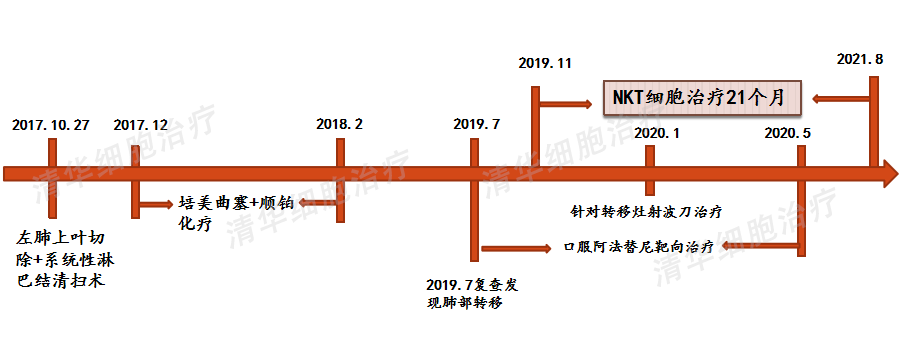
If you find it difficult to understand the subsequent professional descriptions, you can quickly read through this text in two minutes. Ms. Y, born in the 1980s, was diagnosed with lung cancer during her career ascension, when her children were still young and she had elderly family members to take care of. At this age, when she was the "pillar of the family", Ms. Y not only had to focus entirely on the treatment of her disease, but also had to face the challenge of balancing work, family, and life with her husband. The treatment for cancer is long and mentally demanding. Patients in their prime often have to give up their jobs and spend years in the hospital with the company of their family members, which can be even more distressing. However, after choosing NKT cell immunotherapy, Ms. Y not only achieved good results but also freed herself from the time-consuming and mentally exhausting treatment, successfully balancing the relationship between treatment, work, and family. Disease Overview: In October 2017, Ms. Y underwent a chest X-ray that revealed a nodule in the upper lobe of her right lung. She underwent surgery and the postoperative pathology showed: (upper right) invasive moderately differentiated adenocarcinoma with EGFR gene exon 19 deletion mutation. After surgery, she received four cycles of conventional chemotherapy, using pemetrexed combined with cisplatin. However, the stability was only maintained for two years. In July 2019, a follow-up examination revealed new lesions in her right lung, suggesting metastasis. This time, the targeted drug afatinib was used, and although the lesions shrank, Ms. Y experienced significant adverse reactions during the treatment - ulcers, rashes, and diarrhea. Although the targeted drug temporarily inhibited the growth of metastatic lesions, Ms. Y remained worried because in the pathological classification of malignant tumors, the lower the differentiation degree, the worse the prognosis. Ms. Y had moderately differentiated adenocarcinoma, which carries a higher risk. The recurrence that had already occurred left Ms. Y with lingering fears, not only because the side effects of the targeted drug made her feel overwhelmed but also because there was a possibility of drug resistance and eventual failure.
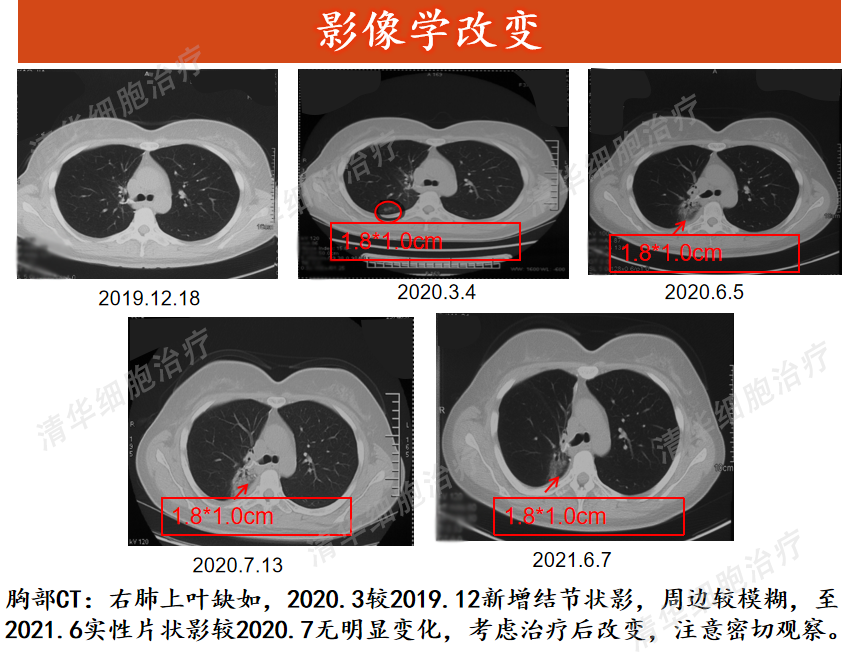
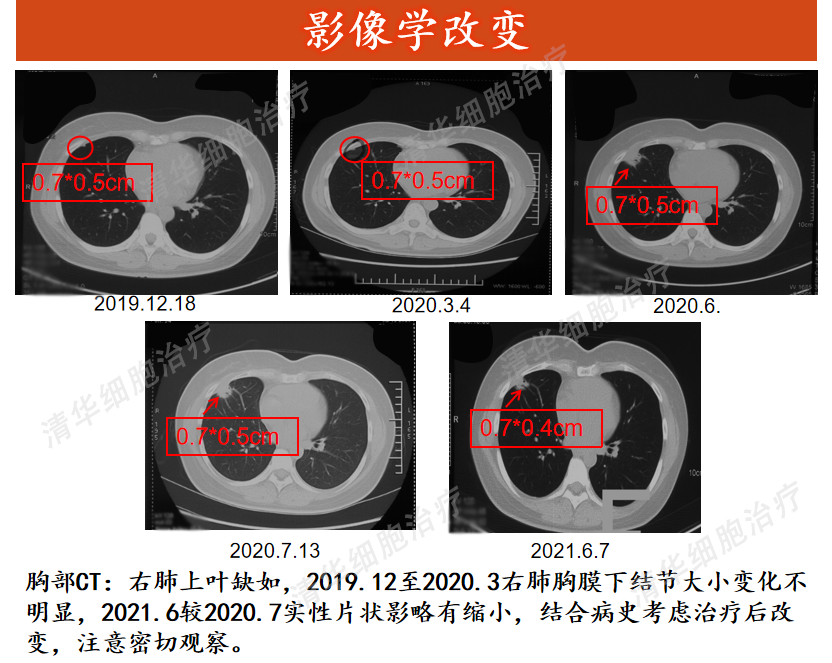
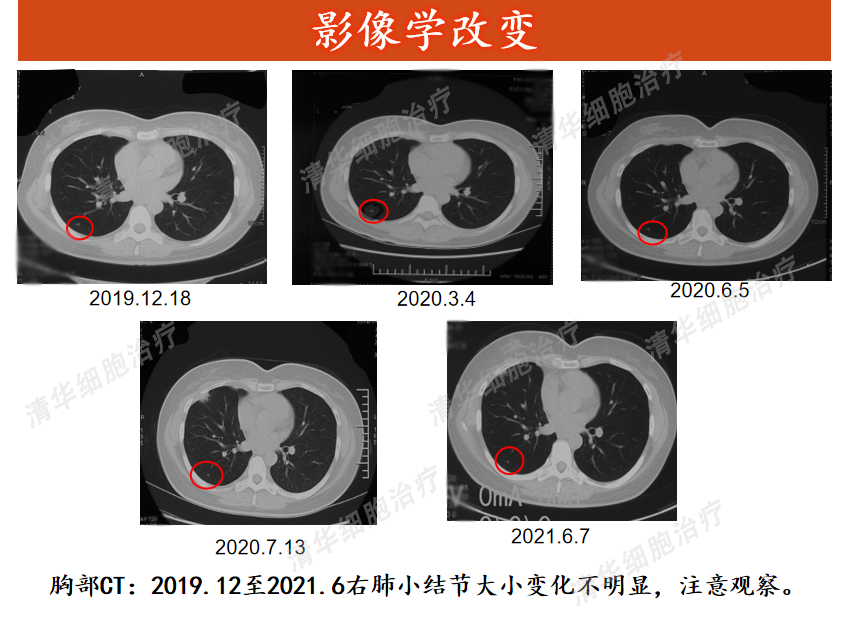
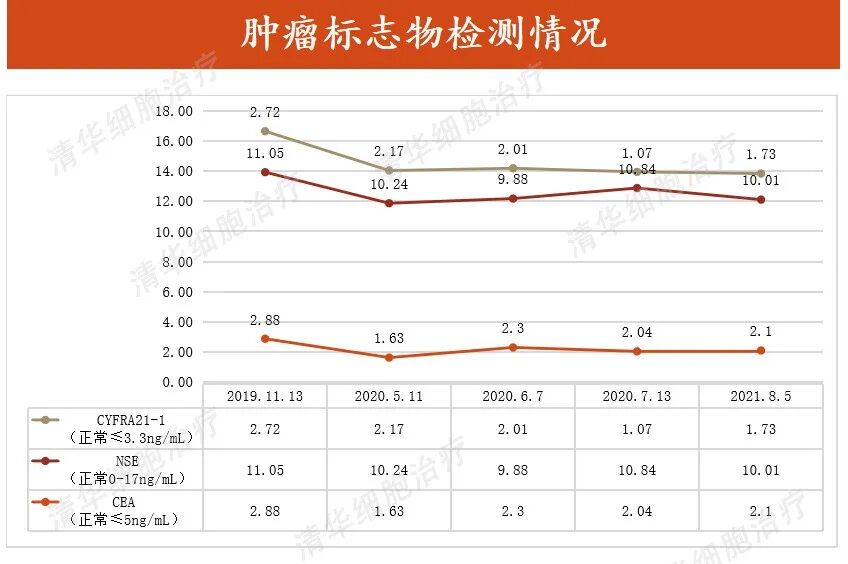
Ms. Y hopes to find a treatment method that can prevent future recurrence and metastasis, is not resistant to drugs, and does not require a lot of time and effort. Through a friend's recommendation, Ms. Y contacted Professor Zhang Minghui's team at Tsinghua University School of Medicine. After analysis, the professor suggested the following treatment plan for Ms. Y: 1) Use precision radiotherapy to locally treat the recurrent lesion, followed by NKT cell therapy to maintain long-term systemic stability. Simultaneously, radiotherapy combined with immunotherapy has the best "abscopal effect"; 2) Postpone targeted therapy, but if there are signs of tumor activity, use targeted drugs for periodic suppression, while maintaining NKT cell therapy to prolong the drug-resistant period. 3) NKT therapy does not require a lot of time and effort, and has basically no side effects, making it very friendly to patients and addressing Ms. Y's concerns. From November 2019 to August 2021, Ms. Y completed 21 months of NKT cell therapy. During this period, three follow-up examinations showed no obvious signs of tumor progression, and the overall evaluation reached 21 months of stability! Imaging Findings: Multiple imaging reviews have shown no significant changes in the size of the nodules under the pleura of the right lung, and no significant changes in the size of the small nodules in the right lung. Tumor Markers: Tumor markers: From November 2019 to August 2021, CEA, NSE, and CYFRA21-1 were all within the normal range . Follow-up is recommended to closely monitor any changes. Quality of Life: During nearly two years of treatment, Ms. Y's physical condition has significantly improved. She reports fewer colds and fever during spring and winter, her hair has become thicker and smoother, and her skin is fairer and more ruddy. She has not missed work, and her quality of life is excellent, with a score of 78.5. Conclusion: Ms. Y achieved her expected treatment goals by adopting the method of precision radiotherapy combined with NKT cell therapy, and successfully addressed her need to balance work and family care. Nearly two years have passed, and the latest assessment results remain stable with no progression. NKT therapy has achieved excellent tumor control for Ms. Y.
Let's look forward to the follow-up presentation next year.