Contact Us Careers
Other Solid Tumors

Immunotherapy provides an additional treatment option for this "metastasis-loving" tumor

时间:2026-04-27 人气:

If you find it difficult to understand the subsequent professional descriptions, you can quickly read through this text within two minutes.

Disease Overview


In March 2014, Ms. Guo discovered a painless mass in her right lower gum. She underwent surgical removal of the mass, and the postoperative pathology indicated a soft tissue sarcoma, with a tendency towards mesenchymal chondrosarcoma or extrabony Ewing's sarcoma, involving bone tissue.
Dept.

Pu

Xiao    
Knowledge

What is the difference between

sarcoma andcancer  
 

Both sarcoma and cancer are classified as malignant tumors, with the primary distinction arising from their different origins and nomenclatures. Malignant tumors originating from epithelial tissue are termed "cancer". For instance, those originating from the skin, nasopharynx, esophagus, and lungs and bronchi are designated as XXX cancer. Conversely, malignant tumors arising from mesenchymal tissue such as bone, fibrous tissue, or lymphatic tissue are referred to as sarcoma. Common examples include osteosarcoma, chondrosarcoma, and fibrosarcoma. The difference between sarcoma and cancer also manifests in prognosis, with the incidence rate of sarcoma significantly lower than that of cancer. Most sarcomas are more difficult to detect and address early on. Additionally, as malignant tumors, sarcomas are less thoroughly studied due to the limited sample size, and treatment options are relatively fewer compared to many common cancers.

Cancer primarily originates from epithelial tissue and is prone to metastasize through the underlying lymphatic vessels; whereas osteosarcoma originates from bone tissue with abundant blood supply, making it more likely to metastasize via the bloodstream, with the most common metastatic site being the lungs, as the lungs collect most of the blood from the body for gas exchange. Sarcomas that metastasize via the bloodstream tend to be more prone to further metastasis.
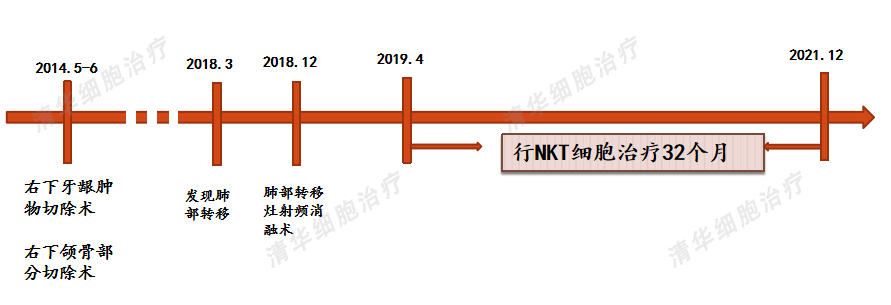
Due to the invasion of bone tissue, Ms. Guo underwent a second surgery on June 25, 2014, involving partial resection of the right mandible.
After two surgeries, Ms. Guo had spent four years in a stable condition, thinking that the tumor had been eradicated.
However, in March 2018, a chest CT scan revealed multiple nodules in both lungs, suggesting metastasis. The biopsy pathology confirmed soft tissue sarcoma with lung metastasis. The fact that metastasis occurred nearly four years after surgery indicates that the expression level of metastasis-related proteins may be low and the malignancy is not high, which is a stroke of luck amidst misfortune.
Six months later, Ms. Guo underwent radiofrequency ablation to treat the metastatic lesions in her right lung. In January 2019, a follow-up chest CT scan showed that the nodules in the middle lobe of her right lung had slightly decreased in size, indicating changes due to the radiofrequency ablation.
Although the metastatic lesions had shrunk (but not disappeared) through radiofrequency ablation, without other interventions, the tumor would most likely continue to progress. Ms. Guo was very worried about this. By chance, she and her family learned about Professor Zhang Minghui's NKT technology at Tsinghua University School of Medicine through a friend's recommendation and carefully reviewed the displayed cases of NKT cell therapy, particularly hoping to try it to reduce the risk of new metastatic lesions in the future.
After reviewing Ms. Guo's medical records, Professor Zhang Minghui made the following analysis and judgment:
1. Although the patient underwent two surgeries, lung metastasis still occurred after four years, indicating that the tumor was still active and had not been completely eradicated.  
2. It was highly prudent for the patient to promptly opt for non-invasive radiofrequency ablation therapy to reduce tumor burden upon discovering lung metastases, paving the way for subsequent NKT cell therapy.  
3. If one simply waits for death after reducing tumor burden, the residual tumor is likely to make a comeback. Next, it is necessary to suppress tumor cells in the body to prevent further tumor progression. NKT therapy utilizes powerful immune cells to eliminate those tumor cells that may remain undetected in the body, with essentially no side effects, making it very patient-friendly. After reducing tumor burden, combined with NKT cell therapy, systemic long-term stability is maintained.  
Ms. Guo underwent NKT cell immunotherapy in April 2019 and has completed 25 courses over a total of 32 months (as of December 2021). During this period, multiple follow-up examinations have shown no signs of significant tumor progression, and the overall assessment is stable!

Image Aspects

Chest CT imaging review revealed nodules with patchy shadows in the right lung middle lobe, which gradually shrunk from January 2019 to July 2019, with no significant changes from July to December 2019 and gradually shrunk again from June 2020 to January 2021. Considering the history of radiofrequency ablation and post-treatment changes, no such patchy shadows were observed from July 2021 to January 2022. There were nodules in the left lung lower lobe with uneven density and calcification visible within, which slightly shrunk from March 2019 compared to January 2019, remained unchanged from March 2019 to June 2020, and were slightly smaller than those in June 2020 from January 2021, with no significant changes from July 2021 to January 2022  

Tumor markers


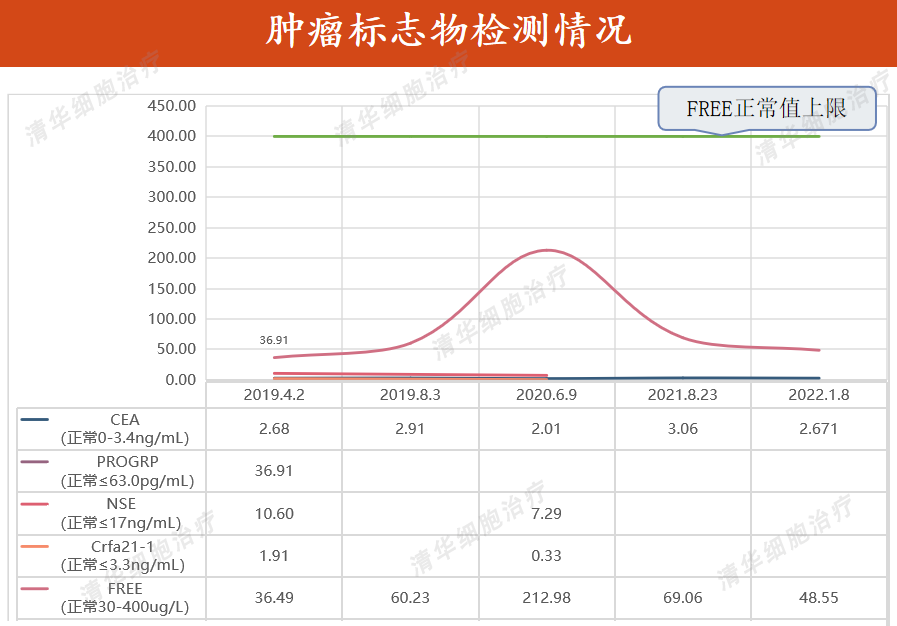
In June 2020, ferritin (FREE) was elevated but did not exceed the normal range (<400ug/L), and was considered to be a physiological fluctuation. From April 2019 to January 2022, no abnormalities were found in tumor markers tested.


Quality of Life


Ms. Guo's quality of life has been greatly improved. Her appetite has significantly improved compared to before treatment, and her mental state is very good, returning to the state before she got sick. She can work and live normally without being affected by the disease.


Conclusion   to


Ms. Guo achieved the desired effect after receiving NKT cell therapy, stabilizing the residual cancer cells and preventing further progression. After more than two years, the latest assessment results remain stable with no signs of progression.
This information is for general knowledge purposes only, and individual patients should follow clinical medical advice.                    
Classic NKT Case Review
Click on the image
to view