Contact Us Careers
Lung Cancer

After lung cancer surgery, cell therapy is used to eliminate residual cancer cells, achieving long-term stability

时间:2026-04-22 人气:

If you cannot understand the subsequent professional description, you can finish reading this text in two minutes

Overview of the disease


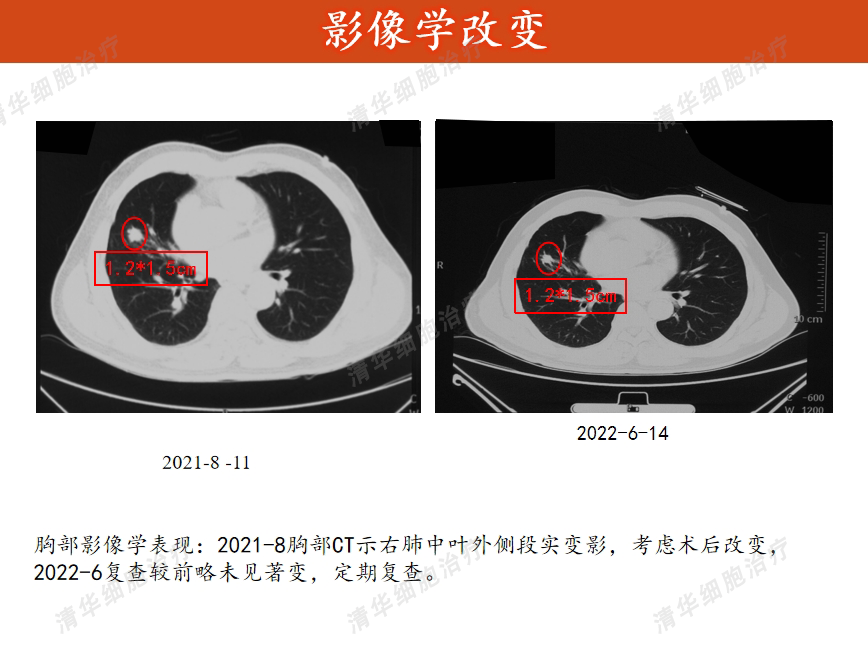
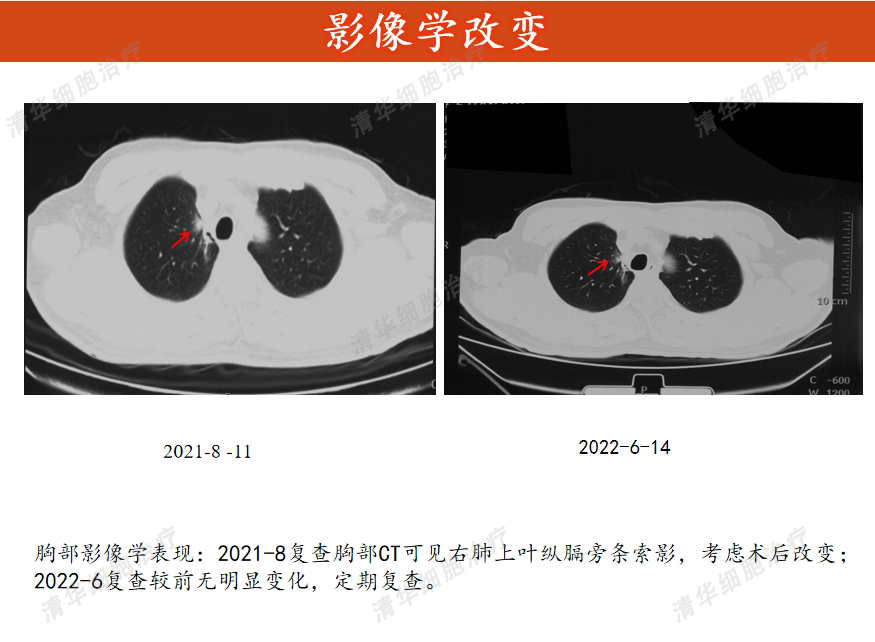
In December 2020, Mr. Ge underwent a chest CT scan, which revealed a mixed ground-glass nodule with a length of approximately 0.6 cm in the apical segment of the right upper lobe of the lung, and another ground-glass nodule of approximately 0.9 cm in the middle lobe of the right lung. Subsequently, in January 2021, he underwent thoracoscopic resection of the anterior segment of the right upper lobe + thoracoscopic wedge resection of the middle lobe of the right lung + thoracoscopic mediastinal lymph node dissection (with nerve protection) + intercostal nerve block analgesia. The intraoperative frozen section pathology report indicated: (nodule in the right upper lobe) adenocarcinoma; the postoperative pathology report showed: the nodule in the middle lobe of the right lung was invasive adenocarcinoma, mainly of the alveolar type, with no clear intravascular tumor thrombus, no nerve or lung membrane invasion, and a tumor diameter of 0.7 cm. No lymph node metastasis was found, and no other treatments were administered postoperatively.
Department

Pu
small
Knowledge
   

knowledge


Indications for lung nodule surgery

Common lung nodules <0.8cm: For nodules with a small volume, clear boundaries, and no spicules, most of these nodules are benign. They are generally observed, with regular follow-up examinations to monitor the changes in the lung nodules.

Nodules >0.8cm: These nodules have a larger diameter, and CT indicates irregular nodule morphology, peripheral spicules, blurred edges, or vascularization and other characteristics suggesting a higher likelihood of malignancy. Radical surgery is required as soon as possible.

Nodules that are ineffective to antibiotic treatment: Lung nodules formed after refractory pulmonary infections can also be treated surgically by removing the lesion.
After reviewing Mr. Ge's medical records, Professor Zhang Minghui made the following analysis and judgment:

1. The patient was diagnosed with lung cancer and underwent surgical treatment, with no clear intravascular cancer thrombus found.

2. Although the patient underwent radical surgery and was at an early stage, he still feared recurrence.

3. NKT therapy utilizes powerful immune cells to eliminate tumor cells that may remain in the body and are undetectable, with essentially no side effects. After completing surgical treatment, combined NKT cell therapy can effectively reduce the incidence of tumor recurrence after surgery. From March 2021 to June 2022, Mr. Ge completed the first phase of treatment (8 courses). During this follow-up examination, no clear signs of tumor recurrence were observed, and his overall condition remains stable  

Imaging
,  


Tumor markers


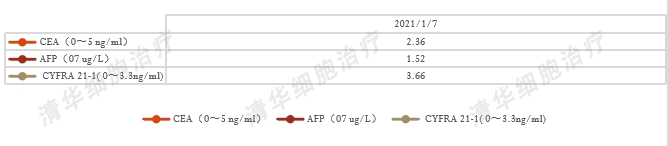
Tumor markers: CYFRA 21-1 in January 2021 was slightly higher than the normal range, while CEA and AFP were normal. Please pay attention to follow-up examinations.


 Conclusion and Comments

Mr. Ge reported that he could carry heavy shopping bags or luggage (over 5kg) for more than 8 minutes, and he felt more energetic than before. The frequency of colds and fever in spring and winter had decreased. His quality of life score was 90 (previously 88). Over half a year, Mr. Ge completed the first phase of treatment. During this follow-up examination, no clear signs of tumor progression were observed, and his overall condition remained stable. We anticipate that subsequent treatments and follow-ups will bring new positive news.
By 2008, lung cancer had surpassed liver cancer to become the leading cause of death among Chinese patients with malignant tumors. The registered mortality rate of lung cancer has increased by 464.84% over the past 30 years. In terms of the treatment of lung cancer, immunotherapy may be more effective in early-stage lung cancer than in advanced-stage lung cancer. In terms of safety, compared to advanced-stage lung cancer, immunotherapy combined with other treatments is safer in the treatment of early-stage lung cancer (the immunotherapies included in this study encompass dozens of immunotherapies such as PD-1 inhibitors, CTLA-4 inhibitors/immune cells).
Mr. Ge underwent radical surgery and did not receive any adjuvant therapy due to his early-stage disease. Mr. Ge was concerned about the side effects of targeted drugs and the potential for future recurrence. NKT cell therapy not only eliminates residual tumor cells but also strengthens the immune system. Most importantly, it has almost no side effects, providing patients with long-term stability .
This information is for general knowledge purposes only and should be based on clinical advice for individual patients.   

References:

[1] Wang, Y., Li, C., Wang, Z., Wang, Z., Wu, R., Wu, Y., Song, Y., & Liu, H. (2022). Comparison between immunotherapy efficacy in early non-small cell lung cancer and advanced non-small cell lung cancer: a systematic review. BMC medicine, 20(1), 426.
[2] She, J., Yang, P., Hong, Q., & Bai, C. (2013). Lung cancer in China: challenges and interventions. Chest, 143(4), 1117–1126
Review of NKT classic cases

Click on the image

to view