Contact Us Careers
Lung Cancer

How malignant is small cell lung cancer with a low survival rate? Besides chemotherapy and radiotherapy, what other effective methods are there

时间:2026-04-27 人气:

Cancer is not terrifying; it can be prevented and treated. The key lies in having the right mindset and scientific methods!

— Tsinghua University. Zhang Minghui

Small cell lung cancer is the most malignant type of lung cancer. In the past, the average survival time for patients with small cell lung cancer was only about six months, and the five-year survival rate was essentially zero.
Although technology has advanced in recent years, clinical data from the past decade indicate that despite the use of multi-drug combination chemotherapy or combined with radiotherapy, the long-term survival rate remains poor, and the local tumor control rate is also unsatisfactory.
Among the various disease cases treated with NKT therapy, cases of small cell lung cancer are very rare. Today, we will present the preliminary treatment results of a patient with small cell lung cancer who underwent treatment for half a year. Follow-up visits will continue, and we will report back to everyone.

Before analyzing this patient's case, let's first understand how malignant small cell lung cancer truly is.

Popular science article: Why is small cell lung cancer so malignant?

Small cell lung cancer mainly occurs in the main bronchus and lobar bronchus, with about 70 percent of cases presenting as perihilar masses. The tumor grows rapidly, with widespread metastasis occurring early, and mediastinal involvement is common, manifesting as superior vena cava syndrome, recurrent laryngeal nerve paralysis, and dysphagia. Distant metastasis to the central nervous system, bones, and liver can occur, leading to corresponding symptoms.


The clinical manifestation of small cell lung cancer is characterized by widespread distant metastasis occurring early. According to literature reports, when small cell lung cancer (SCLC) is diagnosed, 70%~90%% of patients already have clinical or subclinical lymph node metastasis or distant metastasis. The most common sites of metastasis are mediastinal lymph nodes, followed by liver, bone, bone marrow, and brain. Some researchers believe that SCLC has already undergone distant metastasis at the beginning, and therefore treat it as a systemic tumor.
There is now conclusive evidence that small cell carcinoma (SCC) is a poorly differentiated neuroendocrine carcinoma, rather than a small cell variant of undifferentiated carcinoma. In the new WHO classification, SCLC is not classified together with other neuroendocrine tumors, mainly due to the significant differences in clinical characteristics, treatment, and prognosis between SCLC and other types of neuroendocrine tumors.

Chemotherapy is the foundation of treatment for SCLC, and the combination of radiotherapy and chemotherapy is currently the main treatment approach. The 3-year survival rate for concurrent chemoradiotherapy is 20%~30%.

Blood biochemical tests are commonly used for prognosis, and factors predicting poor prognosis include: elevated serum lactate dehydrogenase, alkaline phosphatase, alanine aminotransferase, uric acid, low serum sodium, low serum albumin, low hemoglobin, and neurospecific enolase are also used to predict prognosis.

01

  Case Analysis

If you cannot understand the subsequent professional description

After reading this paragraph in two minutes, you can read
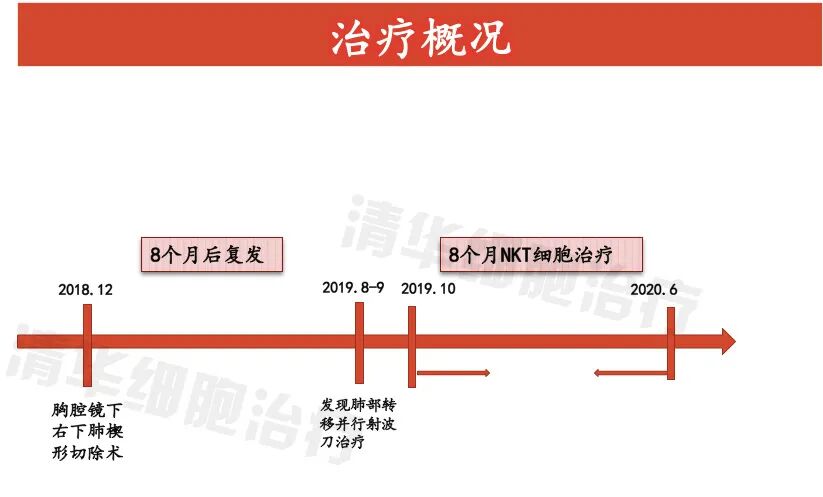
Patient Mr. G from 2014Since April of the year H159, an increase in tumor markers has been observed, but further imaging examinations have shown no significant abnormalities. Subsequently, regular monitoring of changes in tumor markers has shown a gradual upward trend.
Until September 2018, imaging examination revealed a space-occupying lesion in the right lower lung, suggesting malignant tumor. In December of the same year, a thoracoscopic right lowerlung wedge resection was performed. Postoperative pathology showed: (Right lower lung) small cell neuroendocrine carcinoma, moderately to well-differentiated, without invasion of the lung membrane, and no lymph node metastasis (0/5 and 0/1, respectively).
Due to the absence of lymph node metastasis, early detection, and the patient's refusal to undergo chemotherapy, no additional adjuvant therapy was administered post-surgery.
Eight months later, tumor recurrence and metastasis were considered. CT scan revealed a new mass and nodular shadow in the surgical area, measuring approximately 3.2*2.8cm in size, with a nodule in the lumen at the opening of the posterior basal segment, and two nodules under the pleura in the left lower outer basal segment. For this recurrent lesion, the patient opted for cyber knife treatment.
After precision radiotherapy, immediately follow up with NKT cell immunotherapy to reduce the probability of recurrence and metastasis. Due to the malignancy of small cell lung cancer and the fact that patients have not received traditional chemotherapy, the NKT treatment regimen has chosen an enhanced approach, with2 courses per month.
After receiving NKT treatment, what were the results after another 8 months?

After 10 consecutive courses of systematic treatment, the patient's imaging examination showed no signs of recurrence or metastasis. The quality of life improved compared to before, and the physical strength increased. However, the tumor markers did not show a downward trend, and continued observation and follow-up are still necessary.

02

 Imaging data
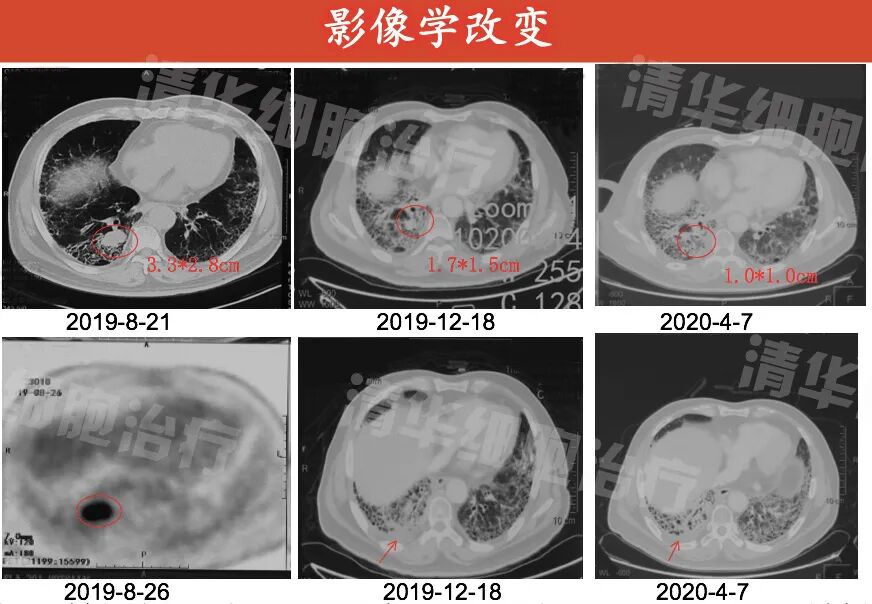
Lung CT: Multiple interstitial fibrosis changes in both lungs, with a 3.3*2.8cm mass shadow visible in the right lower lung on 2019-8-21. Combined with the PET-CT imaging on 2019-8-26, it was considered a metastatic lesion.

, on 2019-12-18, the mass shadow was significantly smaller than that on 2019-8-21, and a small amount of pleural effusion was visible in the right lower lung. Combined with the history of CyberKnife treatment, it was considered a post-treatment change.

On 2020-4-7, the mass shadow was significantly smaller than that on 2019-12-18, and the pleural effusion was slightly absorbed. It is recommended to continue close observation.

Summary of Patient's Condition

This patient with small cell lung cancer has undergone NKT treatment for less than a year, but initial signs of improvement can be observed.
The patient developed new recurrent metastatic lesions eight months after surgery without adjuvant chemotherapy, demonstrating the high malignancy of small cell lung cancer.
However, after eight months, following precise radiotherapy for the metastatic lesions, NKT cell immunotherapy was immediately administered, and no new metastatic lesions have been detected on imaging to date. This indicates that the tumor growth has been initially suppressed or slowed down.

Of course, the patient's current tumor markers have not shown a downward trend. However, considering it took four years from the discovery of elevated tumor markers to the diagnosis of small cell lung cancer, we will continue to follow up the patient in the future, hoping that he can safely pass the 18th and 28th months.

Article reference:

[1]  Modern Oncology  by Tang Zhaoqiu 

Review of NKT Classic Cases

Click on the image

to view


THE  END
上一篇:没有了